
Introducing EVAA Fast Pay: A Smarter Approach to Faster Reimbursements

Most healthcare practices have experienced the same frustrating scenario.
The patient was seen. The documentation was completed. The claim was submitted correctly. Every step in the process appears to have gone according to plan, yet weeks later, the payment still hasn't arrived.
What follows is familiar to most billing teams. Someone checks the claim status. Someone contacts the payer. Someone researches a denial code, gathers supporting documentation, makes corrections, and resubmits the claim. Then the process repeats itself until a resolution is reached.
Meanwhile, new claims continue entering the system.
Over time, these individual delays create larger operational challenges. Accounts receivable begin to age. Administrative workloads increase. Billing teams spend more time chasing reimbursement than supporting revenue growth.
The issue is rarely a lack of effort. Most practices are working harder than ever to keep up with growing administrative demands.
The challenge is that modern revenue cycle management requires two very different capabilities to operate simultaneously: efficiency and persistence.
One ensures claims move through the system quickly. The other ensures claims continue moving when something goes wrong.
Both are necessary for getting paid.
The Two Sides of Revenue Cycle Performance
Healthcare organizations have made tremendous progress through automation over the last several years.
Processes that once required significant manual effort can now be completed in a fraction of the time. Eligibility checks that previously required logging into multiple payer portals can happen automatically. Claims can be submitted with greater accuracy. Insurance payments can be posted without extensive manual data entry.
These improvements matter because every repetitive administrative task removed from the workflow creates additional capacity for the organization.
For a typical practice, EVAA Billing Assistant can eliminate more than five hours of manual billing work each day by automating eligibility verification, claims submission, and insurance payment posting. That time savings translates directly into greater operational efficiency and allows staff to focus on work that requires judgment rather than repetition.
However, many organizations eventually discover that efficiency alone does not determine financial performance.
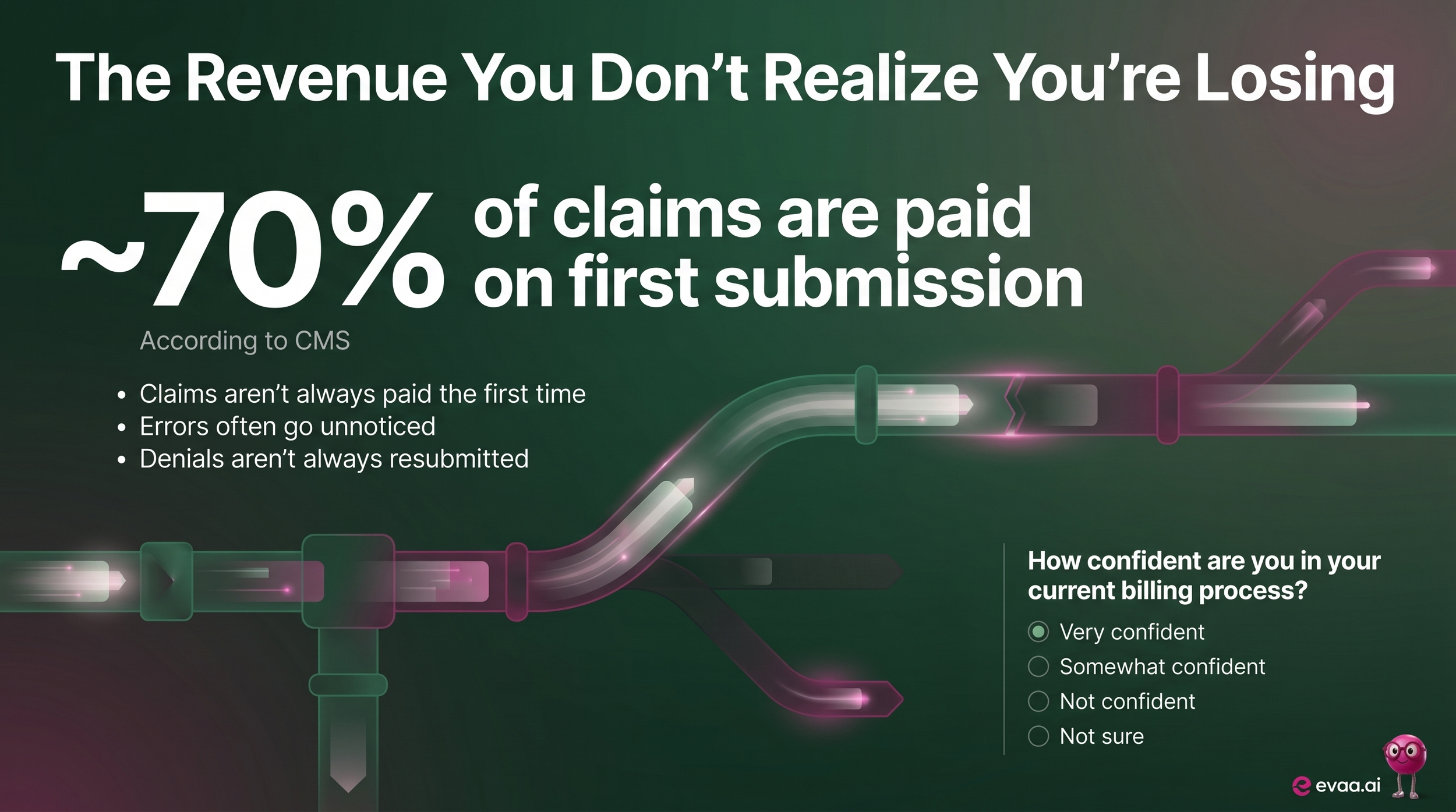
The claims that create the greatest delays are often not the routine claims that move smoothly through automated workflows. They are the exceptions.
They are the denied claims, the stalled claims, and the balances sitting in accounts receivable waiting for investigation and follow-up.
These situations require something automation alone cannot provide.
They require resolution.
Where Revenue Cycles Commonly Slow Down
Every denial creates a chain of events.
Someone must identify the issue, determine the cause, communicate with the payer, gather information, make corrections, document actions taken, and continue following up until a final determination is reached.
Individually, none of these tasks is particularly difficult.
Collectively, they consume a tremendous amount of time.
As claim volume increases, unresolved exceptions begin competing with routine operational responsibilities. Billing teams are forced to divide their attention between processing new claims and managing old ones. Inevitably, some claims receive immediate attention while others remain unresolved longer than they should.
This is where many practices encounter a hidden bottleneck.
They have invested in technology to improve efficiency, yet they still lack the dedicated resources needed to ensure claims continue progressing toward reimbursement after problems occur.
The result is often visible in aging AR reports, delayed cash flow, and a growing administrative burden.
The challenge is not getting claims submitted.
The challenge is getting claims resolved.
Why EVAA Fast Pay Works Differently
EVAA Fast Pay was designed around a simple but important observation: automation and expertise solve different problems.
Automation excels at handling routine, repeatable processes. Human specialists excel at managing exceptions that require investigation, communication, and persistence.
The strongest revenue cycle performance occurs when both are working together.
At the center of EVAA Fast Pay is EVAA Billing Assistant, which automates critical revenue cycle workflows, including eligibility verification, claims submission, insurance payment posting, and unused benefits management.
These automated workflows improve consistency while reducing the administrative burden placed on billing teams. They also help prevent many reimbursement issues before they occur. Practices utilizing EVAA Billing Assistant regularly achieve eligibility verification accuracy exceeding 99% and claims submission accuracy approaching 98%, reducing the likelihood of preventable denials and rework.
However, even highly accurate workflows cannot eliminate every exception.
When claims require intervention, Fast Pay Health specialists become an extension of the practice's team.
These dedicated professionals investigate denials, research claim status, communicate directly with payers, correct issues when appropriate, document next steps, and continue following up until claims reach final resolution.
The objective is not simply to process claims more efficiently.
The objective is to remove the obstacles preventing reimbursement.
The Power of Combining Automation and Expertise
Many organizations have automation tools.
Many organizations have staff responsible for denial management.
Far less common is a system intentionally designed to connect the two.
In many revenue cycles, automated workflows stop when a problem occurs. At that point, claims are moved into separate spreadsheets, work queues, or tracking systems where they are managed independently from the original billing process.
This creates friction, handoffs, and opportunities for delays.
EVAA Fast Pay was built to eliminate those disconnects.
When denial-related issues are resolved, EVAA Billing Assistant automatically picks up the corrected claim and moves it back through the reimbursement workflow. At the same time, Fast Pay Health specialists continue to monitor payer responses and follow up on outstanding balances until reimbursement is received or a final determination is made.
The technology keeps the workflow moving.
The specialists keep the reimbursement moving.
Together, they create continuity throughout the revenue cycle rather than forcing practices to manage disconnected processes.
What That Means for Practices
The benefits of this approach extend well beyond operational efficiency.
When routine billing work is automated and denial management receives dedicated attention, the impact becomes visible throughout the organization.
Claims move through the system more effectively because fewer errors are introduced at the beginning of the process.
Denials receive faster intervention because dedicated specialists are actively managing exceptions. Outstanding balances are addressed before they become long-term collection challenges.
Over time, these improvements begin to reshape the revenue cycle.
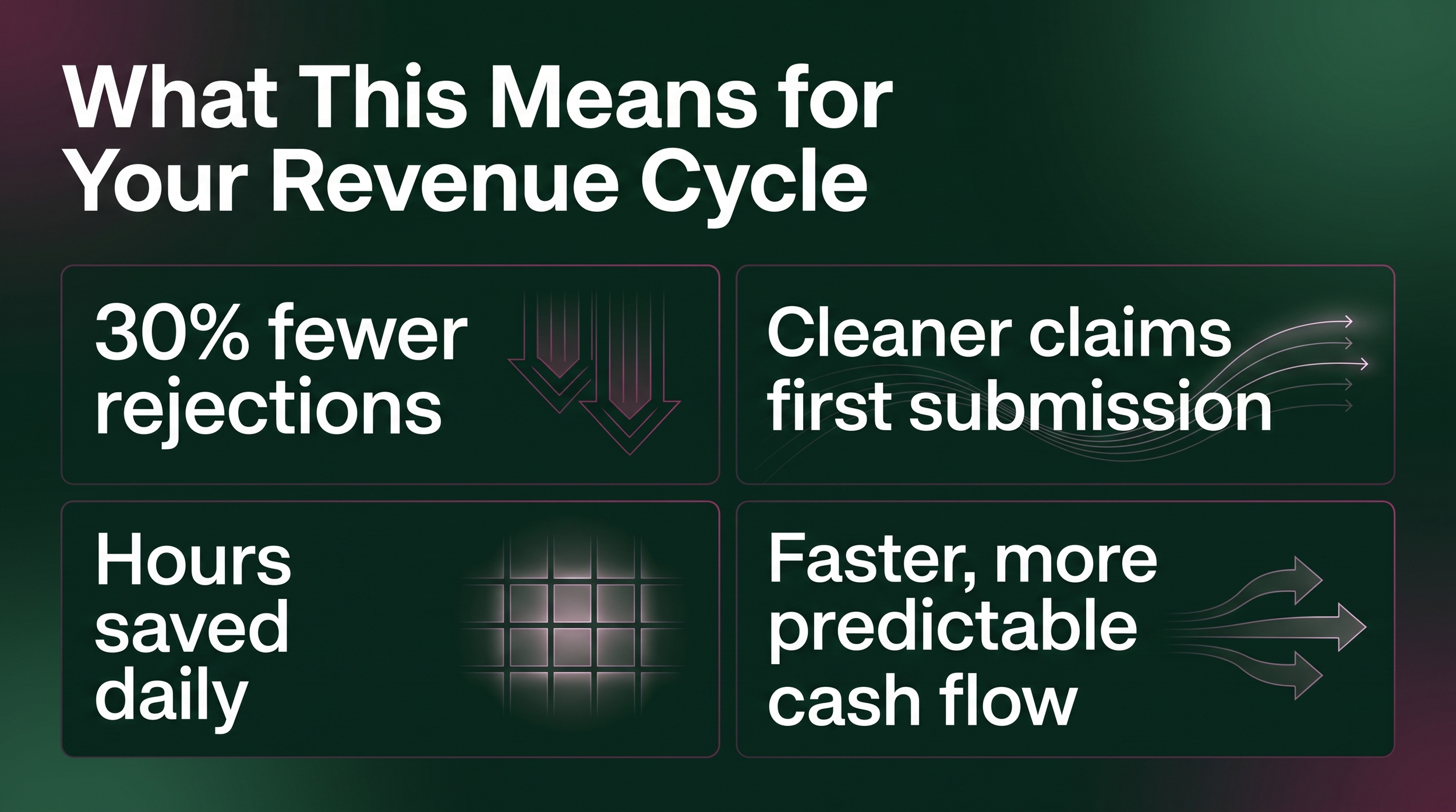
Practices that use EVAA Fast Pay have experienced meaningful reductions in both 60+ and 90+ day accounts receivable balances, as well as faster reimbursement timelines and improved cash flow performance.
These outcomes are not the result of a single feature or workflow. They occur because the entire reimbursement process becomes more connected, more proactive, and more accountable.
Billing teams spend less time reworking preventable issues.
Claims spend less time waiting for attention.
Revenue moves through the organization more consistently.
Perhaps most importantly, practices gain confidence that claims are being actively managed from submission through final resolution rather than quietly aging in the background.
Understanding the Financial Opportunity
Most healthcare management understands the cost of hiring another billing employee.
Far fewer understand the financial impact of delayed reimbursements, unresolved denials, and aging accounts receivable.
The challenge is that these costs rarely appear as a single expense. Instead, they accumulate gradually through delayed cash flow, administrative effort, rework, and missed collection opportunities.
As a result, many organizations know there is room for improvement without fully understanding what that improvement could be worth.
That is why Fast Pay Health developed its ROI Calculator.
The calculator helps practices estimate the financial impact of reducing aging accounts receivable, improving claim accuracy, and accelerating reimbursement timelines based on their own operational characteristics. Rather than relying solely on industry benchmarks, it provides a clearer view of how revenue cycle improvements could affect collections, cash flow, and overall financial performance.
For many organizations, the results are eye-opening.
The opportunity often lies not in submitting more claims.
It is found in collecting more efficiently on the claims already being submitted.
A Smarter Path to Faster Payments
Strong revenue cycle performance has never been solely about technology, nor solely about people.
Technology creates consistency, efficiency, and scale. Experienced specialists provide judgment, persistence, and resolution.
Organizations that rely exclusively on one eventually discover the limitations of the other.
EVAA Fast Pay brings both capabilities together within a single reimbursement strategy designed to help practices reduce administrative burden, improve cash flow, and create a more reliable path from claim submission to payment.
Because getting paid faster is rarely the result of a single process improvement.
More often, it results from building a revenue cycle in which every claim continues to move forward until reimbursement is achieved.
Discover Your Billing ROI. See how the Fast Pay Health + EVAA Bundle could impact your revenue cycle. Use the ROI Calculator to estimate the financial opportunity tied to reducing reimbursement delays, improving collections, and minimizing denial-related work.
